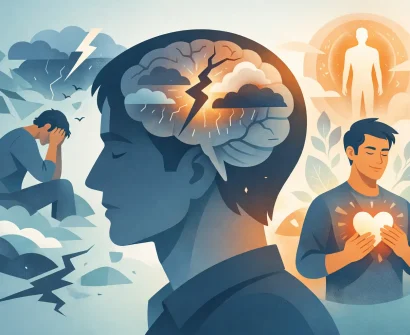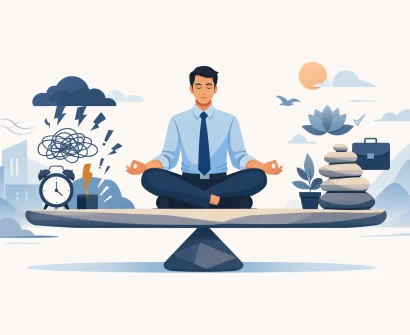



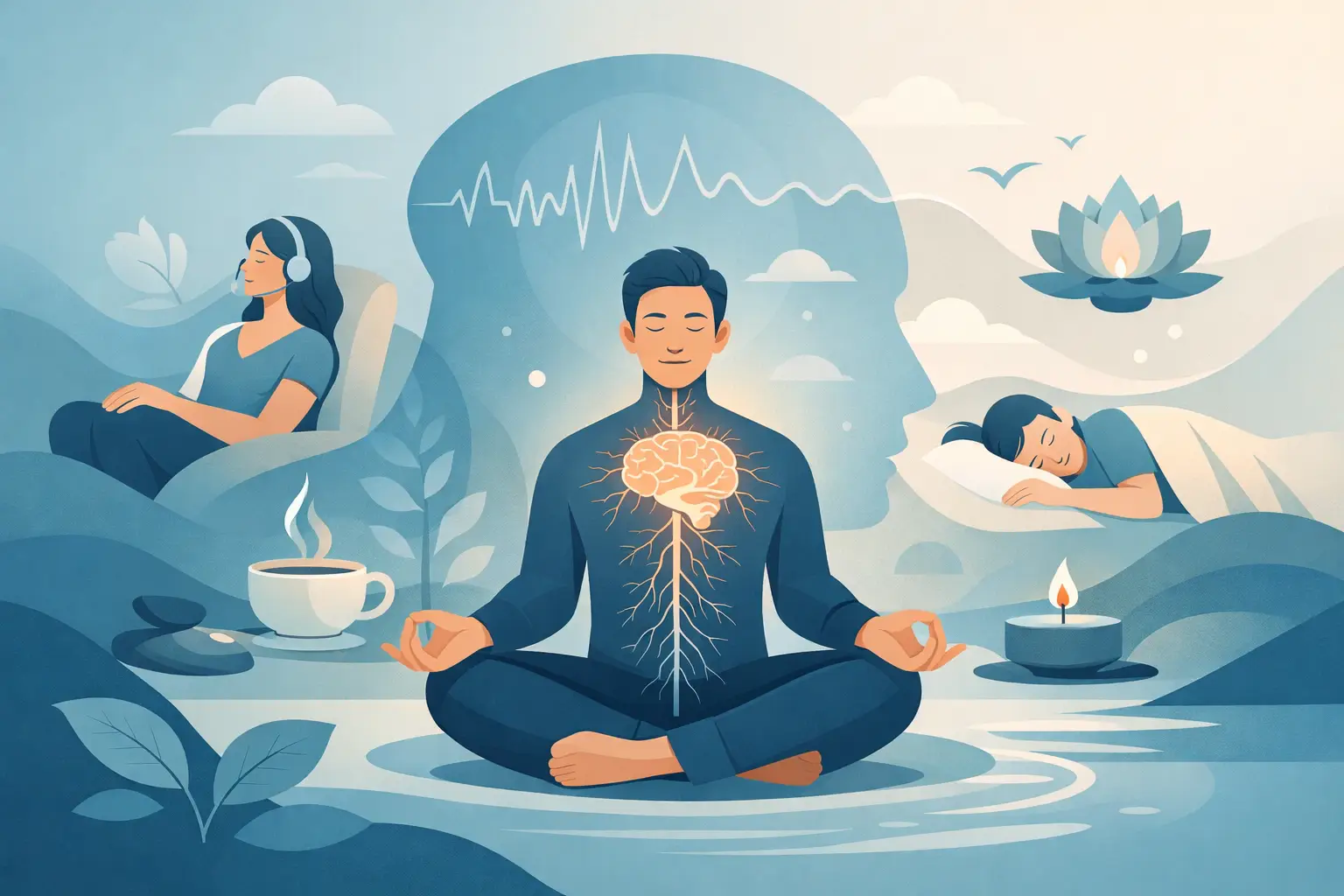
When your body is constantly on edge, simply telling yourself to "calm down" isn't enough. Many people seek the best ways to calm their nervous system because they're tired of silent anxiety, muscle tension, insomnia, and a relentless racing mind that persists even when life seems stable from the outside. The problem isn't a lack of willpower, but rather a nervous system that has learned to perceive staying on the defensive as the safest option.
This point changes everything. Calming the nervous system doesn't begin with forcing yourself to relax, but with understanding what makes the body interpret the present moment as a threat. Sometimes the cause is chronic daily stress, and sometimes it's old experiences that haven't been processed emotionally and psychologically. Therefore, what calms one person may not calm another, and what works today may not be enough tomorrow if the root cause is deeper.
What does it mean if your nervous system is disorganized?
You might not call what you're experiencing a nervous disorder, but you feel it clearly. You wake up tired despite sleeping. You get easily agitated or withdraw suddenly. You find it difficult to concentrate, or you find yourself in a state of hypervigilance, observing everything. The opposite can also occur—numbness, apathy, inner turmoil, and a desire to escape from communication, tasks, and even yourself.
This isn't always a personality flaw. In many cases, it's a clever but exhausting neurological response. The body is trying to protect you in the way it's been taught. When we understand this, we stop treating ourselves as the problem and begin to build inner security instead of just fighting the symptoms.
The best ways to calm the nervous system begin with safety, not control.
The most common mistake is treating relaxation like a task to be completed quickly. You do a breathing exercise, don't feel better, and assume something is wrong. But the nervous system doesn't usually respond to commands; it responds to the relationship. Does it feel safe? Is the pace appropriate? Is what you're doing gentle enough, or is it just another attempt to push yourself?
For this reason, true calming isn't just a quick fix. It's a process of re-educating the body: you're not in danger now. And it can begin with very simple steps if practiced consciously and consistently.
1) Regulating your breathing in a way that does not increase stress
Breathing is a powerful tool, but not every breath is suitable for every situation. Some people, especially those with a history of anxiety or trauma, may experience increased discomfort when asked to take very deep breaths. It's often best to start gently—exhaling slightly longer than inhaling, without overdoing it, and without trying to achieve perfect breathing.
For example, you could try inhaling calmly for a count of four, then exhaling for a count of six, for just a few cycles. The point isn't the number, but the message it sends to your body: there's no need to panic. And if focusing on your breath bothers you, that's important too. Don't force it. Switch to a safer method.
2) Returning to the body instead of remaining in the head
When stress is high, the mind tends to overanalyze. But the nervous system isn't always calmed by internal dialogue alone. Sometimes it needs direct sensory cues. Mindfully place your feet on the floor, press your palms together, wrap yourself in a blanket, or slowly drink something warm. These small details may seem trivial, but they speak to the body in its own language.
The nervous system doesn't always require extensive experience. It needs faithful repetition of clear safety signals. And the more present the body is, the less likely you are to jump to alarmist mental scenarios.
3) Reduce inputs, not increase attempts
Some people, when they feel overwhelmed, add more—self-help content, stimulants, reminders, resolutions, tasks. But an overworked nervous system often needs the opposite. It needs relief. Less light. Fewer screens. Fewer alerts. Less draining conversations.
This isn't a luxury. If you're working under immense pressure and appear to be performing at a high level on the outside, your body may be silently paying the price. Part of calming down is acknowledging that capacity is limited, and that excessive endurance isn't always a sign of health. Sometimes the shortest path to balance is to stop pushing yourself too hard.
Ways to calm the nervous system when experiencing momentary anxiety
When you're experiencing a severe wave of anxiety, you don't need a long speech. You need something you can do right now. This is where what's called orientation or spatial awareness comes in handy. Look around slowly and name five things you see. Not as a school exercise, but as a way to tell your brain that you're here, in this room, in this moment, and not trapped in a frightening memory or anticipation.
Simple movement can also help. It doesn't have to be strenuous exercise. Sometimes a short walk, a wave of the arms, a shoulder stretch, or simply releasing excess energy from the body instead of letting it circulate internally is enough. Some bodies need complete rest, while others need a gentle release first, followed by rest. It depends on your individual needs.
This is where the importance of listening, rather than imitating, becomes clear. If meditation makes you feel more anxious, it doesn't mean you've failed. It might simply mean your body needs a different approach. And if calming music doesn't help but slow walking does, that's valuable information, not an embarrassing exception.
When quick fixes don't work
There are moments when common advice is useless because your nervous system isn't just dealing with the stresses of a normal day, but with deeper layers of fear, coping mechanisms, or unresolved pain. At these times, the question isn't: How do I stop the episode now? Rather, what makes this episode recur in the first place?
This is the difference between palliative care and true regulation. Palliative care may calm you for a few hours. True regulation, however, builds a broader capacity to remain present without collapsing or constantly on edge. This often requires deeper work, especially if the symptoms are chronic—persistent anxiety, dissociation, overreactions that are out of place, or an internal feeling of insecurity even when there is no apparent danger.
In these cases, trauma-based approaches can be very helpful because they don't just ask what you're doing now, but what happened to your nervous system that caused it to function this way. Methods that consider the body, defense mechanisms, and internal mechanisms, such as certain models of therapeutic action and body awareness, can open a completely different door—not a door to control, but a door to healing.
What helps to provide sustained calming of the nervous system?
Sustainability comes from consistency, not fleeting excitement. Regular sleep is important, but not just as general advice. The nervous system is influenced by the repetition of signals. Consistent bedtimes, good exposure to morning light, and reduced pre-night stimulation all teach the body to expect security rather than sudden, alarming surprises.
Relationships are also a crucial part of neuroregulation. Some people believe that calming themselves should be entirely solitary. But the nervous system also regulates itself through secure connection. A calm voice, a non-judgmental presence, a space where you don't feel the need to defend or pretend. This is why the effect of a deep, therapeutic, or counseling relationship can be so profound—because it gives the body a new experience: I can be present without being rejected, forced, or misunderstood.
Food and stimulants do play a role, but without oversimplifying the issue. Not all anxiety is caused by coffee, but some sensitive bodies are indeed affected by caffeine, insufficient food intake, or sharp fluctuations in blood sugar. If your body is already in a state of heightened alertness, any factor that exacerbates the anxiety deserves attention.
When do you need deeper support?
If you're constantly trying different approaches and finding only temporary relief, or if you feel your body is stuck in strong reactions despite your awareness and understanding, it might be time for specialized, trauma-sensitive support. This doesn't mean your situation is hopeless. On the contrary, it often means your nervous system needs more nuanced guidance, not more effort on your part alone.
Good support doesn't begin by correcting you, but by understanding you. It doesn't assume your problem is a lack of discipline, but asks about your body's history, your patterns, your defenses, and what hasn't been adequately addressed. This kind of work is what makes calming more than just tools; it makes it a gradual return to yourself.
In a space like the one Montaser Moussa offers, the focus is on the root, not the surface. This is important for those who have tried many quick fixes and still feel that something deeper remains untouched.
If your nervous system is exhausted, you don't need to win another battle against yourself. You might just need to start from a more compassionate, more honest place. A gentle step, repeated often enough, can restore your body's confidence that peace isn't a distant idea—but an experience that can be cultivated from within.